
Using AI chatbots for health questions: the who, what, and why

The portion of US adults using AI chatbots for health questions has nearly tripled in the last two years, from around 21% in November 2023 (Consumer Reports) to around 60% according to an OpenAI survey reported in January 2026. As AI chatbot activity may influence people’s health behaviors and health care use, it’s important to understand the who, what and why:
Who: which populations use AI chatbots for health more than others?
What AI chatbots are people using for health questions?
Why are people using AI chatbots for health?
This report addresses these questions. It is the first in a four-part series examining how people use AI chatbots for health questions based on an online survey of 400 U.S. adults in December 2025 by Bluemont Health Consulting LLC. Survey methods are described here. We compare the results to results from other recent surveys at the end of the report.
Results in brief
The who
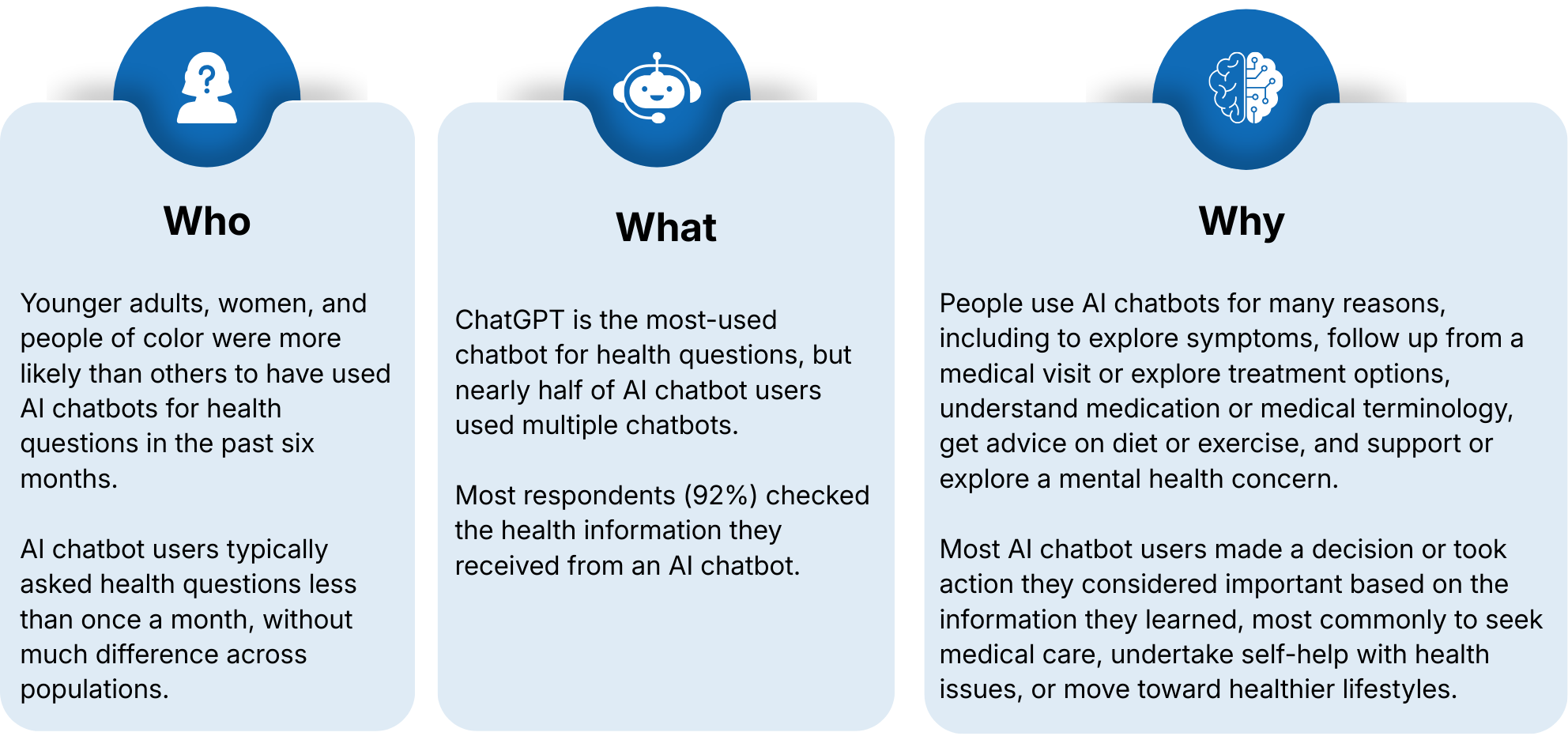
Younger adults, women, and people of color were more likely than others to have used AI chatbots for health questions in the past six months. Among all respondents, 56% had used an AI chatbot for health questions. Most people who had not used an AI chatbot for health questions had also not used a chatbot for other topics (74%). Below, for ease of presentation, “AI chatbot users” refers to respondents who used AI chatbots for health questions.
Exhibit 1. Use of an AI chatbot for health questions: percentage of respondents using one in the past six months by age, race/ethnicity, region, urban/rural location, and sex (n=400)

AI chatbot users typically asked health questions less than once a month, without much difference across populations. About three-fourths of responding AI chatbot users reported asking about health 1 to 5 times in the past 6 months. Only one population difference was borderline statistically significant: among AI chatbot users, men were more likely to have asked health questions frequently, with 31% of men vs. 20% of women using one 6 or more times in the past 6 months (p=.06).
The what
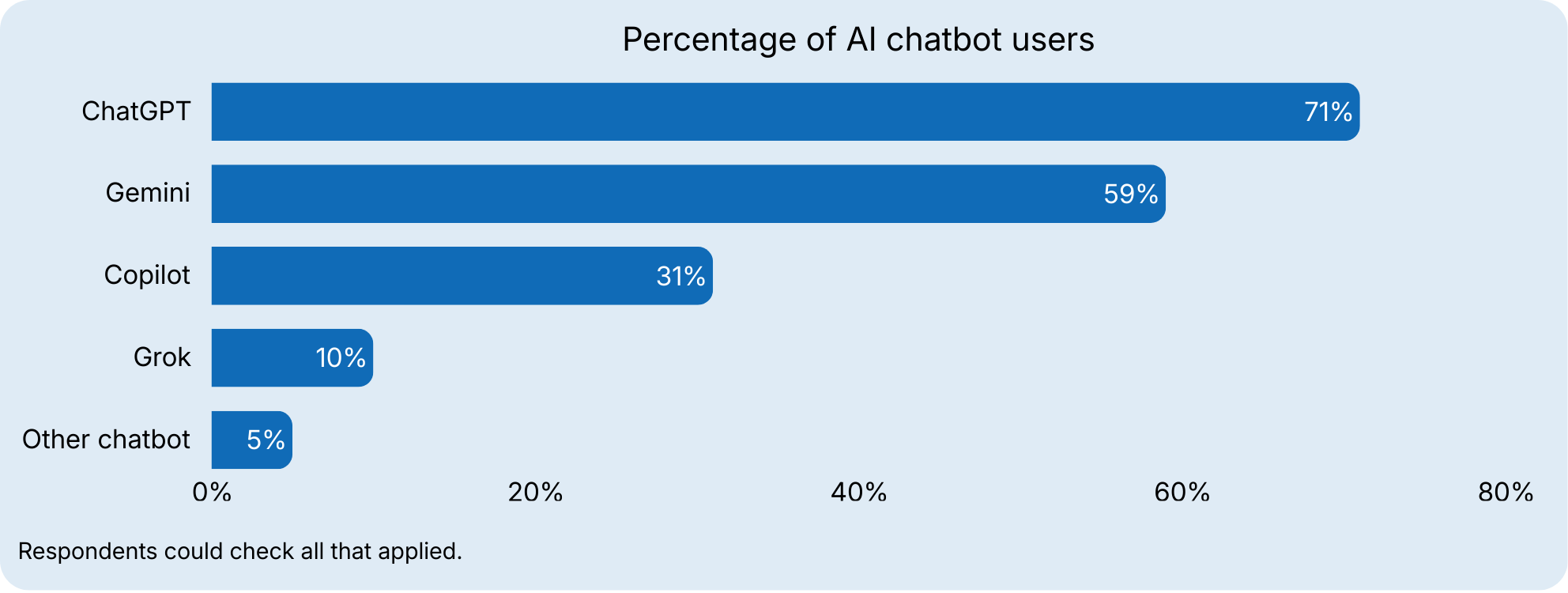
ChatGPT is the most-used chatbot for health questions, but nearly half of AI chatbot users (48%) used multiple chatbots. Few indicated they used another chatbot not listed on the survey for health questions.
Exhibit 2. Chatbots used for health questions (n=226)
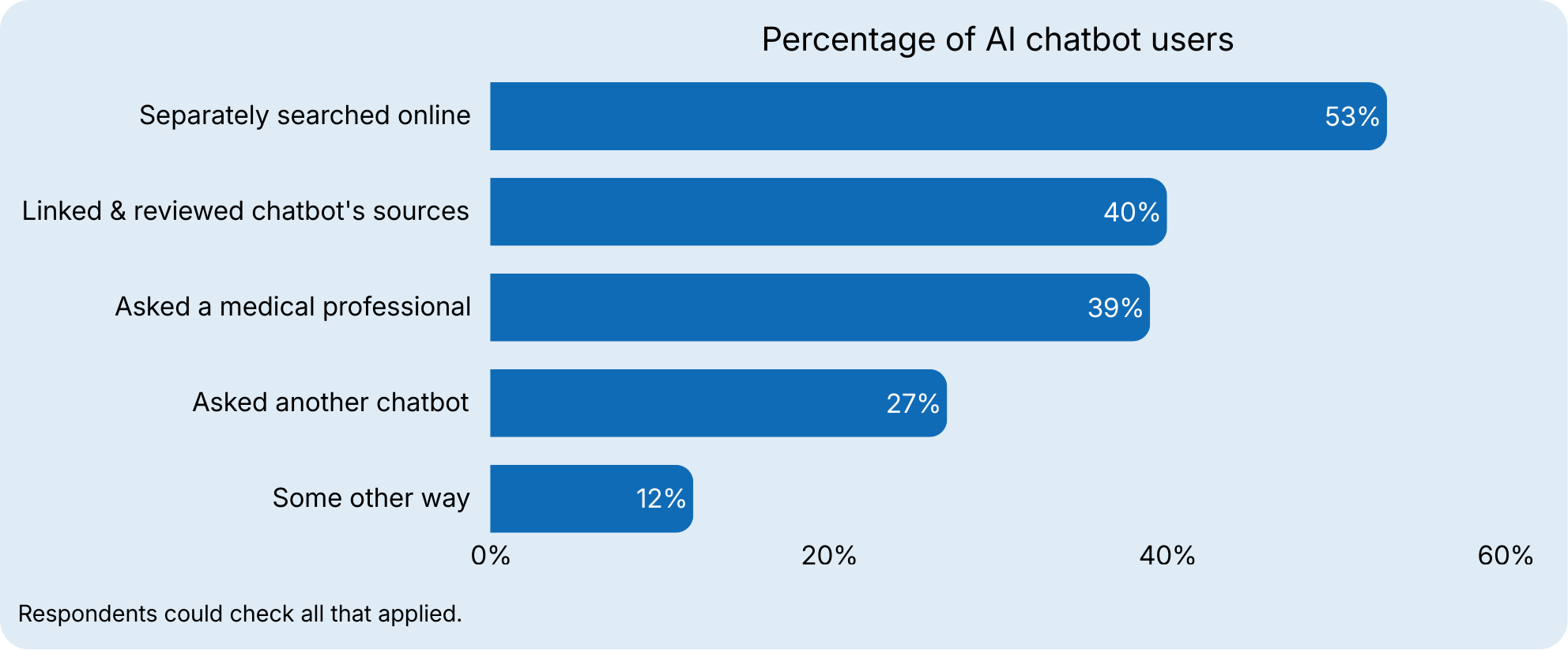
Most respondents (92%) checked the health information they received from an AI chatbot. For many, AI continued to help with this checking. Over half of AI chatbot users (53%) checked chatbots’ information through a separate online search, and about one-fourth checked by asking another chatbot (Exhibit 3). Since online searches now typically generate an AI-powered summary, the difference between using an AI chatbot and online searches has become blurred. People also commonly checked their information by linking to and reviewing the chatbot’s sources, and asking a medical professional.
Exhibit 3. How people checked health information they received from AI chatbots (n=226)
The why
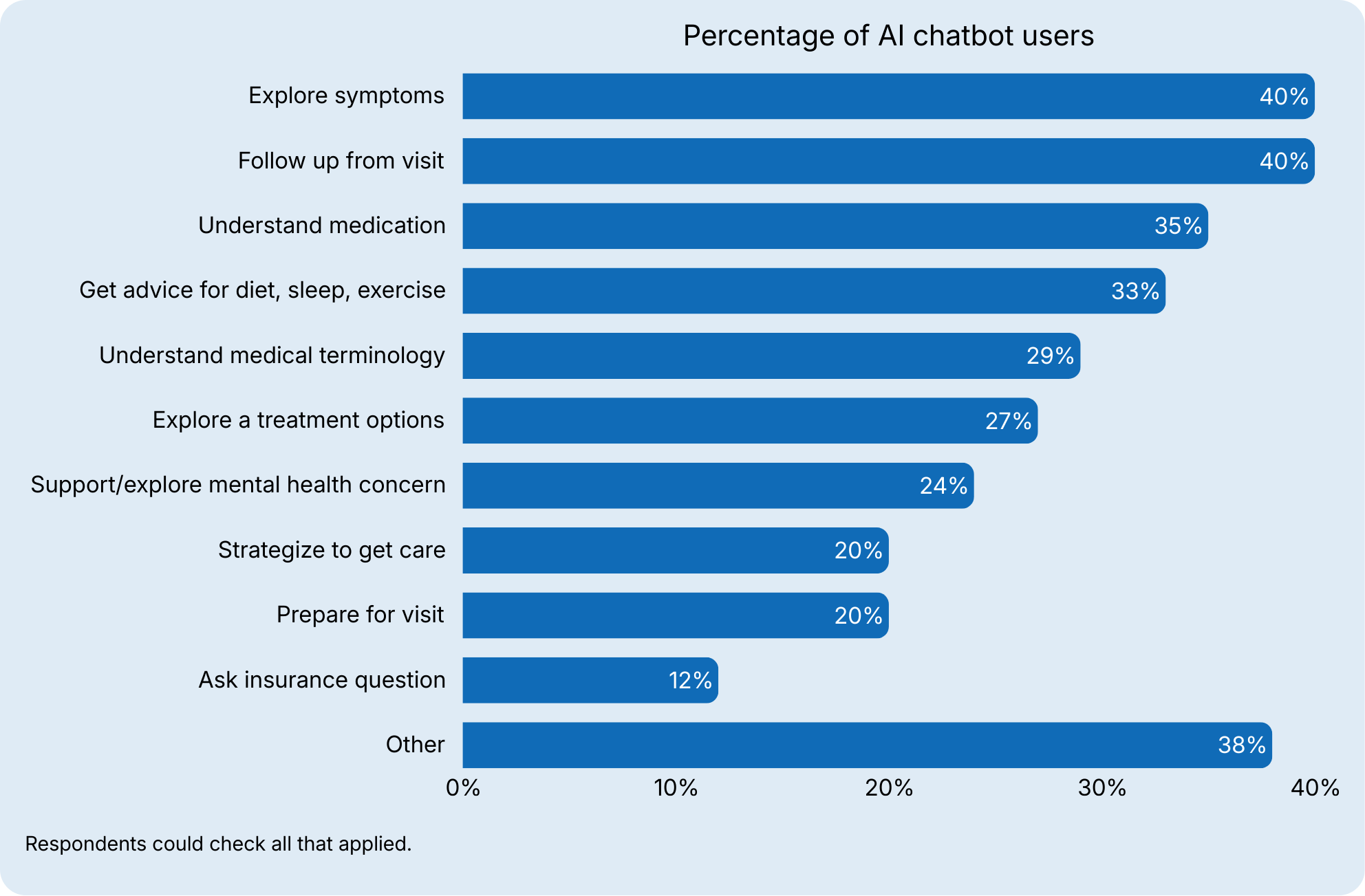
People use AI chatbots for many reasons, including to
explore symptoms,
follow up from a medical visit or explore treatment options,
understand medication or medical terminology,
get advice for diet, exercise, or sleep, and
support or explore a mental health concern (Exhibit 4).
Most AI chatbot users (78%) checked multiple reasons from the list we offered.
Exhibit 4. Reasons people used AI chatbots for health questions in the past 6 months (n=226)
Receiving information is not the same as acting on it – making a decision or acting on information takes more effort, and has more consequences.
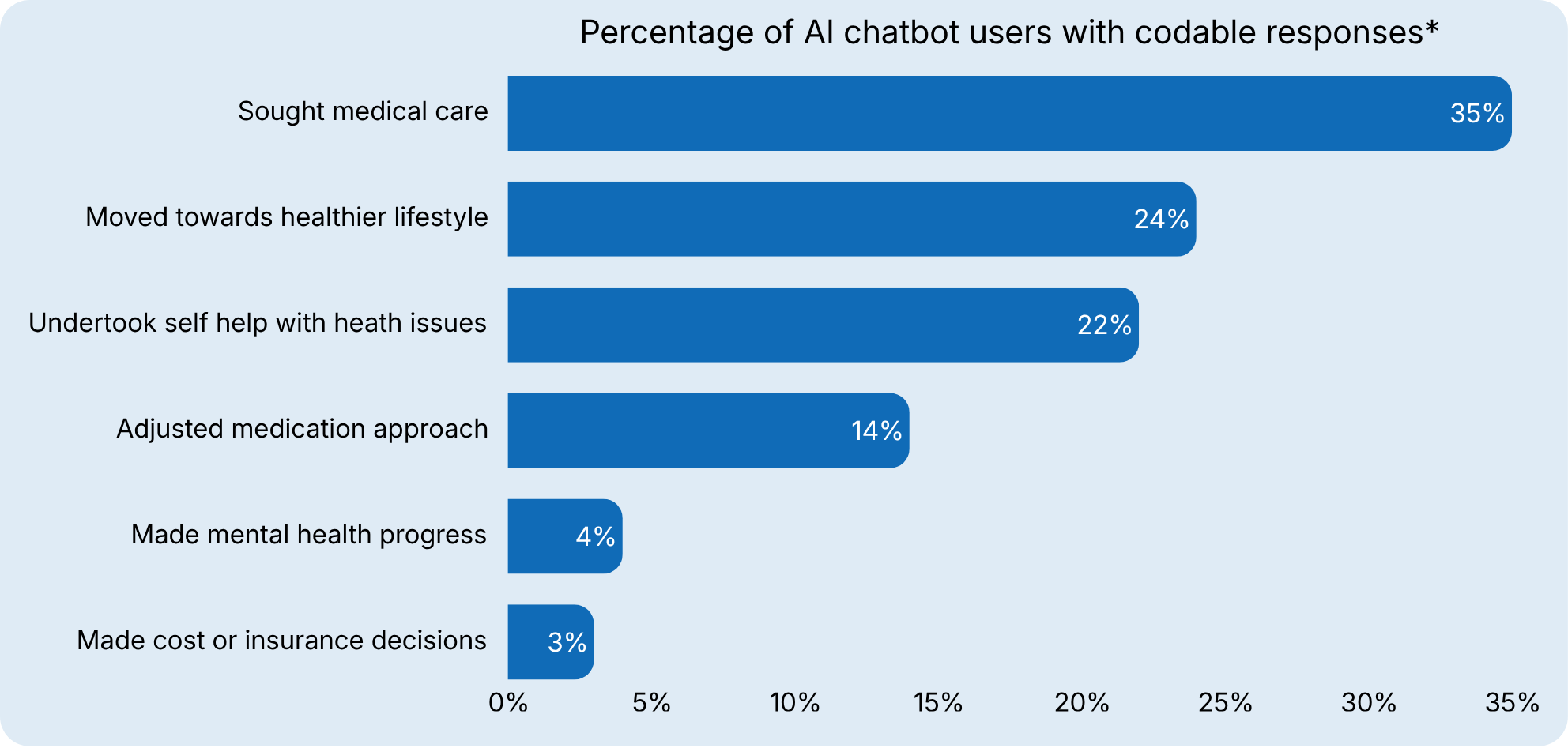
Most AI chatbot users (89%) made a decision or took action they considered important at least once in the past six months based on the information they learned, most commonly to seek medical care, undertake self-help with health issues, or move toward healthier lifestyles. About a third (36%) had taken at least 3 actions or decisions in the past 6 months based on the AI chatbot’s health information.
We asked those who had taken some action what was the most important decision or action they had taken in response to AI chatbot advice or information, as an open-ended question. Exhibit 5 summarizes their responses.
Exhibit 5. Summary of people’s self-described most important actions or decisions as a result of AI chatbot information or advice (n=156)
Considering these results in the context of other recent polls and surveys
Our results are generally consistent with and complementary to other research, when we consider the rapid growth in AI chatbot use over the past few years. Only surveys since late 2023 are considered relevant and discussed below, and even then the older surveys are expected to (and do) have lower percentages of people using chatbots for various reasons just due to the overall increased use.
Who uses AI chatbots for health. Consistent with other sources, adults ages 65 and older were much less likely than other respondents in our survey to have used an AI chatbot for health. However, finding that 25% of the older adults group used them is higher than another recent survey that used a larger sample and included a phone option for response found 14% of adults 50 and older used an AI chatbot for health (Institute for Healthcare Policy and Innovation, February 2025). We did not find sources for other demographic information on who uses AI chatbots for health.
What chatbots people are using. While health-specific chatbot data do not appear to be available, general data show ChatGPT is far more frequently used than others, consistent with our results. Gemini, Copilot, and Grok, which respondents were also using, were also in the top 10. Other U.S. firms in the top 10 for general chatbot use are Perplexity, Claude, Poe, and Meta AI (Venditti, August 2025).
Checking chatbot information. Our findings that most people checked chatbots’ health information are consistent with another survey, conducted by the University of Pennsylvania in April 2025, which found only 8% rarely or never go beyond the AI-generated response, and about two-thirds often or always check the information in some way (Annenberg Public Policy Center, July 2025).
Why people use AI chatbots for health. Three surveys since November 2023 are relevant to consider along with our findings. Each sample is different, so where there are differences, sampling differences could play a role as well as the other theories suggested below.
A January 2026 OpenAI survey finds that of AI chatbot users who used one to manage health in the past 3 months:
55% used it to check or explore symptoms (40% in this survey),
48% used it to understand terms or instructions (50% here, once the two related items are combined), and
44% used it to learn about treatment options (27% in this survey)
The higher OpenAI numbers are likely due to their including people who used an AI chatbot to manage their health in the past 3 months, whereas we included anyone who had asked health questions of an AI chatbot in the past 6 months.
A January 2024 Ipsos survey listed 12 possible reasons consumers might use generative AI for health, and found overall lower percentages for their items than we did. This was likely due to the increase in overall use of AI chatbots during 2024 and 2025, and perhaps from increased public attention to certain health topics such as diet and exercise—with the growth in GLP-1s and wearables—in the past two years. For example,
32% used it to check symptoms (40% in this survey)
16% used it to get guidance about lifestyle modifications (33% in this survey)
10% used it for mental health support (24% in this survey)
15% used it to find out which healthcare practitioners to speak to (20% in this survey)
20% used it to check available treatments (27% in this survey)
A November 2023 Consumer Reports survey included a section on health-related uses of chatbots, and asked about people’s use of a chatbot for 8 health-related activities. The percent to said they used it for each activity was only between 1 and 8%.
The most comparable reasons to those listed our survey were:
7% looked up a symptom to see if someone was sick (40% in this survey)
8% looked up what a medical term means (29% in this survey)
In addition to being the oldest survey (we would expect considerably lower numbers in late 2023), we think their very specific question wording played a role for some items. For example, we would expect a higher percentage to indicate they used an AI chatbot as worded in this survey for “advice on diet, exercise, or sleep,” versus on each of three separate items for “develop a meal plan,” “develop an exercise routine,” or “look up nutrition facts.”
Sources
Annenberg Public Policy Center, University of Pennsylvania. Many in U.S. Consider AI-Generated Health Information Useful and Reliable, July 14, 2025.
https://www.annenbergpublicpolicycenter.org/many-in-u-s-consider-ai-generated-health-information-useful-and-reliable/
Choy, Vanessa, Sara Martin, and Ashley Lumpkin. “Can we rely on generative AI for healthcare information?” Ipsos: 2024. https://www.ipsos.com/en-us/can-we-rely-generative-ai-healthcare-information
Consumer Reports Survey Group. “A.I.Chatbots: Two Consumer Reports Nationally Representative Internet Surveys: August and November 2023.” December 29, 2023.
https://advocacy.consumerreports.org/press_release/consumer-reports-surveys-american-consumers-about-how-they-use-and-think-about-text-based-generative-ai-chatbots/
Institute for Health Policy and Innovation, University of Michigan. “How Older Adults Use and Think About AI.” July/August 2025. https://ihpi.umich.edu/national-poll-healthy-aging/national-findings/how-older-adults-use-and-think-about-ai
OpenAI. “AI as a Healthcare Ally: How Americans are navigating the system with ChatGPT.” January 2026. https://cdn.openai.com/pdf/2cb29276-68cd-4ec6-a5f4-c01c5e7a36e9/OpenAI-AI-as-a-Healthcare-Ally-Jan-2026.pdf
Venditti, Bruno. “The 10 Most-Used AI Chatbots in 2025.” August 28, 2025. https://www.visualcapitalist.com/the-10-most-used-ai-chatbots-in-2025/