
Medicare patients using drugs to be covered by the GUARD cost reduction model may on average have taken 10 medications the prior year
Authors: Hanzhi Zhou and Suzanne Felt-Lisk

To reduce prescription drug costs in Medicare Part D, the CMS Center for Medicare and Medicaid Innovation (CMS/CMMI) plans to launch the five-year Guarding U.S. Medicare Against Rising Drug Costs (GUARD) model on January 1, 2027 as one of several recent federal drug price reduction initiatives (Felt-Lisk 2026).
Who are the Medicare beneficiaries whose drug prices will be reduced by GUARD? In this analysis, we compare the demographic characteristics, drug expenses, and drug access for Medicare beneficiaries who used GUARD-eligible drugs with other Medicare beneficiaries, using 2023 Medical Expenditure Panel Survey (MEPS) data.
Two limitations are worth stating up front. First, the list of potentially GUARD-eligible drugs we used is a rough approximation, because the GUARD model has not been finalized, and the high-spend threshold could not be applied with the available data. Second, MEPS identifies only a portion of GUARD-eligible drugs by name. Many high-cost specialty drugs appear only under broad category labels, so the beneficiaries we can observe are a partial, and likely lower-cost, slice of those the model will likely reach. These results should be read as a conservative first look, not a full portrait.
We find Medicare beneficiaries who used GUARD-eligible drugs were similar to others in terms of their demographic characteristics, but used a larger number of distinct prescription drugs—averaging 10 prescriptions in 2023, and had higher total and out-of-pocket expenditures for drugs.
While Medicare drug coverage policy changes since 2023 likely reduced the spending burden of this group, they are clearly a medically vulnerable group. Taking more than 10 prescription drugs—common for this group—has been called excess polypharmacy and is associated with higher rates of hospitalization and mortality (Chae et al. 2024; van Dam et al. 2022). This may mean the model is appropriately focused if these beneficiaries experience lower out-of-pocket costs or indirect benefits through changes in coverage or premiums. At the same time, GUARD could trigger a complex set of responses from manufacturers, Part D plans, and other stakeholders, creating unintended consequences (Felt-Lisk 2026).
Because this population appears to be especially medically vulnerable, it will be important to monitor changes in their prescription drug coverage, out-of-pocket spending, and medication adherence as the model unfolds.
Background
The GUARD model is a CMS Innovation Center demonstration that seeks to reduce Part D spending on selected, high-cost prescription drugs while maintaining beneficiary access and quality. Under current law, manufacturers owe inflation rebates when prices for certain Part D drugs increase faster than inflation. Beginning in 2027, the GUARD model will test a modified rebate calculation for participating drugs that incorporates a Most Favored Nation (MFN) price benchmark based on manufacturer prices in 19 comparator countries. Because U.S. prices for many brand-name drugs have historically exceeded prices in these countries, CMS expects the model to test whether this approach can reduce Medicare spending while preserving access to needed medications.
Drugs are eligible for the GUARD model when they are (CMS 2025):
single-source Part D drugs eligible for inflation rebate reporting,
associated with at least $69 million in gross Part D spending over a 12-month period, and
in one of 17 selected drug categories.
Although the model is not yet finalized, a recent analysis based on the proposed rule found over 170 drugs may be eligible for GUARD, that may account for almost $93 billion in gross Part D spending, representing approximately 32% of all Part D drug spending in 2024 (Getachew et al. 2026).
The same analysis found a majority of drugs that would qualify for inclusion fall under just five of the 17 possible categories: antineoplastics, blood glucose regulators, immunological agents, respiratory tract/pulmonary agents, and antivirals (Getachew et al. 2026). For more GUARD background, see Felt-Lisk 2026 (overview) or CMS 2025 (detail).
Since the time the MEPS data used in the analysis presented here were collected, policy changes took effect that reduced Medicare beneficiaries' spending for prescription drugs. In particular, before January 1, 2025, there was a "donut hole" in coverage; after meeting their deductible, beneficiaries would pay 25% of drug costs until reaching a spending threshold, after which they would pay 100% until meeting a catastrophic coverage threshold. Beginning in January 2025, this "donut hole" was eliminated and total out-of-pocket expenditures were capped (at $2,100 for 2026). This is important for interpreting our analysis, because the beneficiaries' out-of-pocket expenditures would likely have been lower if they were incurred in 2026, just prior to GUARD model implementation. However, affordability challenges still persist for some, since nine percent of Medicare beneficiaries reported that they decided not to fill a prescription in 2025 due to cost (CMS 2025).
Who are the beneficiaries whose drug prices will be reduced by GUARD?
Demographic characteristics
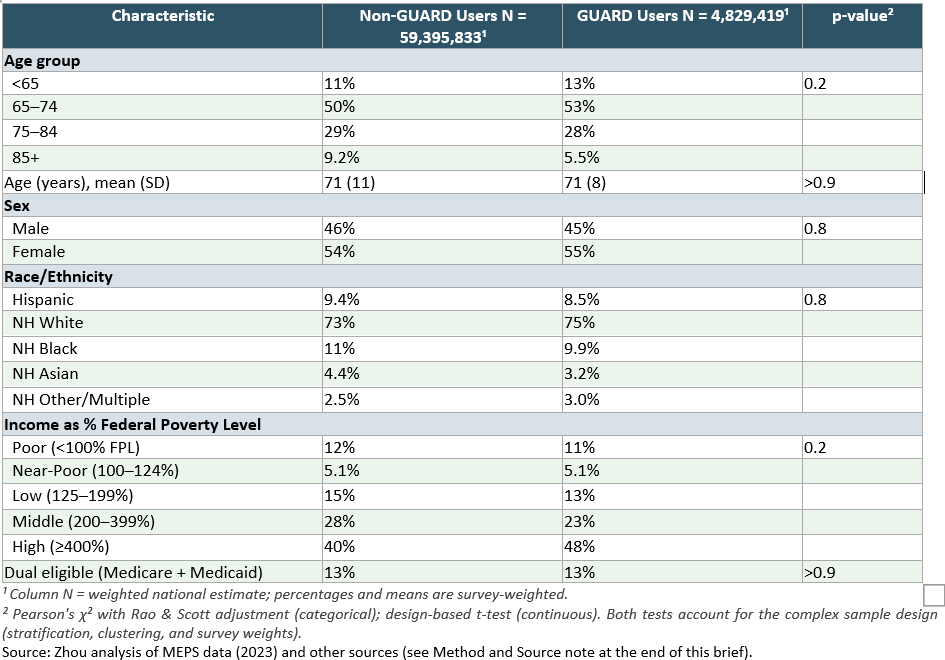
Medicare beneficiaries who used GUARD-eligible drugs in 2023 were similar to other beneficiaries in age, sex, race/ethnicity, and income level (Table 1).
Table 1. Demographic characteristics of Medicare beneficiaries using drugs likely eligible for GUARD, in 2023
Drug expenditures and access
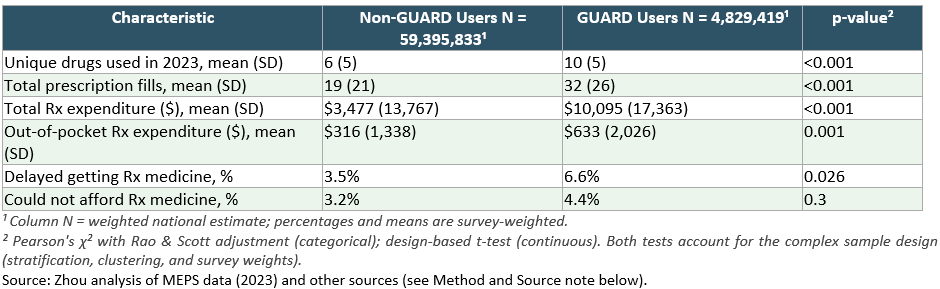
Medicare beneficiaries who used GUARD-eligible drugs in 2023 (Table 2):
had taken many more prescription drugs in 2023 than others, on average (10 vs. 6)
had much higher average out-of-pocket expenditures for drugs than others ($633 vs. $316)
showed a higher rate of delayed prescription fills than others (6.6% vs. 3.5%), though this difference was not statistically robust—it was borderline in the main analysis (p = 0.026) and fell below significance in sensitivity analyses (p = 0.054)—and should be interpreted very cautiously given the small number of GUARD users reporting a delay
The percentage who reported they could not afford their medication was also higher than others but not statistically significant. A sensitivity analysis restricting the non-GUARD comparison group to beneficiaries with at least one prescription fill (roughly 10% of non-GUARD Medicare beneficiaries had zero drug spending in 2023) confirmed that the spending and utilization differences were robust, while the delayed prescription finding remained non-significant (p = 0.054), reinforcing the need for caution in interpreting that result.
Table 2. Drug expenditures and access for Medicare beneficiaries using drugs likely eligible for GUARD, in 2023
Method
We used the 2023 Medical Expenditure Panel Survey (MEPS) to identify Medicare beneficiaries and estimate their demographic characteristics, drug utilization, expenditures, and access barriers. The MEPS is a nationally representative survey of the U.S. civilian noninstitutionalized population, conducted by the Agency for Healthcare Research and Quality (AHRQ). Medicare beneficiaries were identified using the Full-Year Consolidated file, and prescription drug records were drawn from the Prescribed Medicines file.
GUARD-eligible drug users were identified by matching prescription fills to a proxy list of 105 sole-source, non-MFP-negotiated Part D drugs spanning all 17 USP Medicare Model Guideline therapeutic categories designated in the GUARD proposed rule. The list was assembled from a candidate pool of Part D drugs in the CMS Medicare Part D Inflation Rebate Fact Sheets (Applicable Periods 1 and 2) and verified drug-by-drug against the FDA Orange Book (small-molecule drugs), FDA Purple Book (biologics), biosimilar launch announcements, and payer formulary sources to confirm the absence of an approved and commercially launched generic or biosimilar as of mid-2026.
Drugs selected for CMS Maximum Fair Price (MFP) negotiation under IPAY2026 or IPAY2027 were excluded, as the GUARD model explicitly removes MFP-negotiated drugs. The third GUARD eligibility criterion — at least $69 million in gross Part D spending over a 12-month period — could not be verified from publicly available data and was not applied; this is a stated limitation.¹ Matching to MEPS was performed on the generic drug name field (RXDRGNAM), the active ingredient string, rather than the brand name, because the Prescribed Medicines file records each fill by active ingredient regardless of which product was dispensed — a single ingredient entry therefore captures all formulations in one match. Brand-name string matching was used as a secondary fallback for multi-ingredient combination products where MEPS may record the brand name rather than the ingredient string.
All analyses applied the MEPS appropriate survey weights and design variables to produce nationally representative estimates. Comparisons between GUARD and non-GUARD Medicare beneficiaries used Pearson's chi-square with Rao-Scott adjustment for categorical variables and design-based t-tests for continuous variables. Subpopulation estimation followed domain analysis methods recommended for complex survey data, with the survey design object constructed on the full MEPS sample prior to subsetting to the Medicare population.
The analysis is based on 361 unweighted MEPS respondents identified as likely GUARD drug users (out of approximately 4,859 Medicare respondents in the 2023 MEPS sample), representing a weighted national estimate of approximately 4.8 million Medicare beneficiaries. Access findings — particularly delayed prescription fills, reported by 24 of the 361 GUARD respondents — are based on small event counts and should be interpreted cautiously.
Limitations
This analysis has important limitations. First, the proxy drug list is not the same as the future, final GUARD-eligible drug set. The final model rule and CMS administrative claims data will be needed to verify all three eligibility criteria when that becomes possible. Also, the starting candidate pool was drawn from the CMS Medicare Part D Inflation Rebate Fact Sheets (AP1 and AP2), which list drugs that owed inflation rebates — a subset of all Part D rebatable drugs limited to those whose prices rose faster than inflation — rather than from the full universe of GUARD-eligible products, for which no list is available; this means our list may miss drugs whose prices did not increase faster than inflation but that are otherwise GUARD-eligible. We did confirm that the list nevertheless included most of the sole-source drugs that were captured in the 2023 MEPS Prescribed Medicines file.
Second, the $69 million gross Part D spending threshold, which is a required GUARD eligibility criterion, could not be verified from publicly available data and was not applied; the proxy list therefore includes drugs that fall below this threshold. We conducted a sensitivity test with the spending limit applied using the old (2023) data and the results were robust to the test, so we used the larger list of drugs.
Third, sole-source status was verified using the FDA Orange Book and Purple Book, which may not capture real-time generic or biosimilar launch information at the precise reference date. Fourth, ingredient-level MEPS matching does not distinguish between formulations of the same active ingredient, which may introduce minor misclassification in either direction. The 2023 MEPS data pre-date the elimination of the Medicare Part D "donut hole" (January 2025) and the implementation of the out-of-pocket cap ($2,100 in 2026); beneficiary spending patterns at the time of model launch (January 2027) will differ from those observed here.
Source note
The following key data sources were used in drug list compilation:
(a) CMS Medicare Part D Inflation Rebate Fact Sheets AP1 and AP2 — candidate pool of Part D drugs eligible for inflation rebate reporting (cms.gov/priorities/medicare-prescription-drug-affordability);
(b) FDA Orange Book — patent and exclusivity listings for small-molecule drugs, used to identify approved generics (accessdata.fda.gov/scripts/cder/ob/);
(c) FDA Purple Book — biosimilar reference product listings for biologics (purplebooksearch.fda.gov/);
(d) drugs.com and GoodRx generic availability pages — secondary source for confirming commercial launch status of approved generics;
(e) CMS IPAY2026 and IPAY2027 Maximum Fair Price drug lists — used to identify and exclude MFP-negotiated drugs (cms.gov/medicare/prescription-drug-coverage/negotiated-prices);
(f) CMS Medicare Part D Spending by Drug public dataset — used to validate that drugs appear in Part D claims (data.cms.gov/summary-statistics-on-use-and-payments/medicare-medicaid-spending-by-drug/medicare-part-d-spending-by-drug).
References
Centers for Medicare & Medicaid Services (CMS). "Guarding U.S. Medicare against rising drug costs (GUARD) model." Proposed Rule. Federal Register, vol. 90 n. 244, December 23, 2025: 60338–60429. https://www.federalregister.gov/documents/2025/12/23/2025-23705/guarding-us-medicare-against-rising-drug-costs-guard-model
Chae J, Cho HJ, Yoon S-H and Kim D-S (2024). “The association between continuous polypharmacy and hospitalization, emergency department visits, and death in older adults: a nationwide large cohort study.” Frontiers in Pharmacology. 15:1382990. doi: 10.3389/fphar.2024.1382990 https://www.frontiersin.org/journals/pharmacology/articles/10.3389/fphar.2024.1382990/full
Felt-Lisk S. "Understanding recent federal efforts to reduce prescription drug costs." Bluemont Health Consulting LLC, July 2026. https://www.bluemonthealth.com/insights/federal-efforts-to-reduce-drug-costs
Getachew B, K Stengel, M Brown, and T Meyer. "Over 170 drugs may qualify for inclusion in the GUARD model." Avalere Health, February 2026. https://advisory.avalerehealth.com/insights/over-170-drugs-may-qualify-for-inclusion-in-the-guard-model
van Dam CS, Labuschagne HA, van Keulen K, Kramers C, Kleipool EE, Hoogendijk EO, Knol W, Nanayakkara PWB, Muller M, Trappenburg MC, Peters MJL. “Polypharmacy, comorbidity and frailty: a complex interplay in older patients at the emergency department.” European Geriatric Medicine 2022 Aug;13(4):849-857. doi: 10.1007/s41999-022-00664-y. Epub 2022 Jun 20. PMID: 35723840; PMCID: PMC9378326. https://pubmed.ncbi.nlm.nih.gov/35723840/