Understanding recent federal efforts to reduce prescription drug costs
Information current as of July 15, 2026. Download the brief here.
The past several years have seen a major expansion of federal efforts to reduce prescription drug costs. Based on an environmental scan, this brief consolidates key information for health policy professionals who understand Medicare and Medicaid but who are not drug pricing experts. We also consider likely effects of these initiatives on patients.
While the remainder of this brief focuses on recent federal initiatives, several private-sector organizations are also pursuing strategies to improve prescription drug affordability (Appendix A). These efforts will continue alongside the federal initiatives and may interact with some of them, but they do not change drug prices through regulation or negotiation as do the federal initiatives.
Why federal efforts to reduce prescription drug costs are important
Paying for prescription drugs is a major consumer concern (Kearney et al. 2026). Nearly six in ten U.S. adults (59%) report worrying about their ability to afford prescription medications, and about one in four report that they or someone in their household has had difficulty paying for prescription drugs. From the same survey in spring 2026, nearly one in five of those with Medicare ages 65 and older report they are “very worried” about being able to afford prescription drug costs for them or their family. This level of worry is similar to what was seen in 2018, despite major policy changes since then from the Inflation Reduction Act that reduced out-of-pocket (OOP) costs. The changes included expanding the low-income subsidy (LIS) eligibility to 150% of the poverty level (LIS covers most OOP costs for prescription drugs), and capping OOP expenses over the year at $2,100 for 2026 (MedPAC 2025).
Reducing prescription drug costs can contribute to a larger goal of reducing the overall high and rising cost of health care. Expenditure data for 2024 show health care represents 18 percent of the U.S. economy, and rising annual health care spending has been outpacing overall economic growth (Hartman et al. 2026). With retail prescription drugs constituting 9% of total health care spending (Hartman et al. 2026), and drugs administered directly by clinicians accounting for an estimated additional 4-5% of total health care spending (Roehrig and Turner 2022), initiatives to reduce the cost of drugs have an important contribution to make to overall health care cost reduction efforts.
Americans pay substantially higher prices for prescription drugs than people in other high-income countries. U.S. prescription drug prices averaged 2.78 times those in 33 Organization for Economic Co-operation and Development (OECD) comparison countries in 2022. In addition, prices for brand-name drugs remained more than three times higher even after accounting for estimated rebates (ASPE 2024). The study also found that the price gap has widened over time, largely because U.S. prices for brand-name drugs have grown faster than those in comparable countries.
Summary of recent federal approaches
Recent federal initiatives are working to lower the price of prescription drugs by negotiating prices directly with manufacturers, establishing a consumer-facing drug price platform reflecting voluntary manufacturer discounts, and testing new pricing and payment models, including several that incorporate Most Favored Nation pricing, discussed more below (Exhibit 1).
Exhibit 1. The three primary ways federal initiatives are working to reduce prescription drug prices
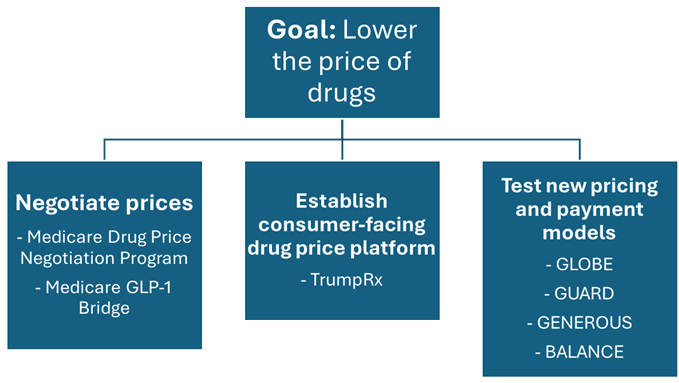
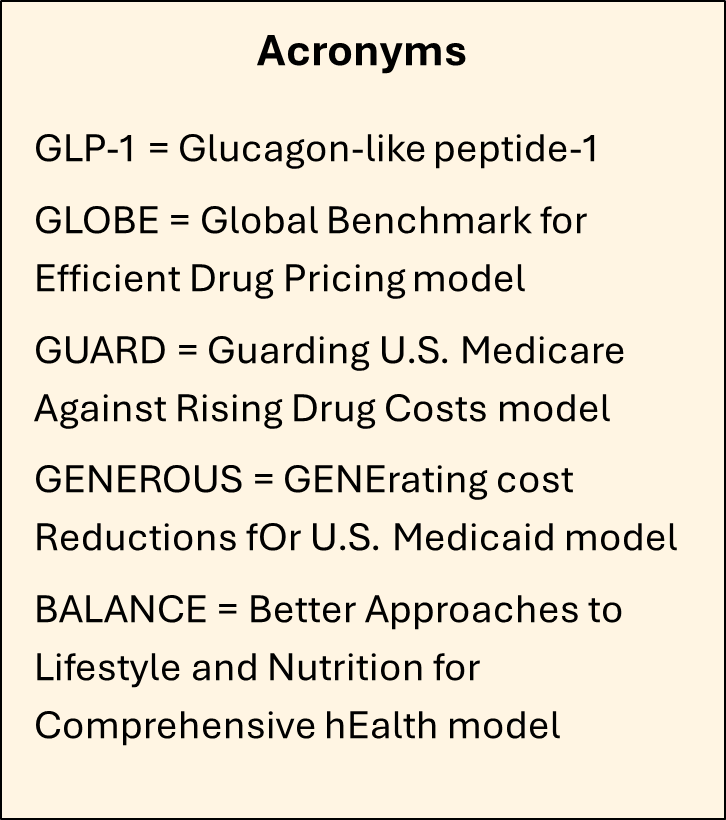
Federal initiatives extend broadly across health programs, and cover different subsets of drugs. The initiatives work to address drug prices in Medicare (Medicare Drug Price Negotiation Program, GLOBE, GUARD, BALANCE, and Medicare GLP-1 Bridge), Medicaid (GENEROUS and BALANCE), and self-pay markets (TrumpRx). In general, the initiatives have prioritized sole-source (no competition), brand-name drugs that through their cost and frequent use account for substantial government spending.
The government’s new role as a price negotiator for Medicare now takes place on an annual cycle. The Centers for Medicare & Medicaid Services (CMS) is currently (July 2026) negotiating directly with manufacturers for the third cycle of negotiations as part of the Medicare Drug Price Negotiation Program. Prices on 10 drugs were negotiated for the first cycle and 15 additional drugs in the second, with 15 more in process for the third.
TrumpRx is operational, with 17 manufacturers having signed related agreements to publish discounted cash prices for some of their drugs. The subset of drugs with discounts available upon launch has expanded to include more than 600 generic medications, and to integrate discounts available through private pharmacy programs—thus far including Amazon Pharmacy, Cost Plus Drugs, and GoodRx (The White House 2026).
The Center for Medicare and Medicaid Innovation (CMMI) in CMS is in the process of finalizing and rolling out GLOBE, GUARD, GENEROUS, and BALANCE as multi-year financial model demonstrations affecting payments and/or rebates.
Each CMMI model has a different role to play in drug price reduction within the Medicare and Medicaid programs. For example, GLOBE and GUARD pertain to certain categories of Medicare Part B (clinician-administered) and Part D (retail) drugs, respectively; GENEROUS focuses on state Medicaid agencies that wish to participate; and BALANCE has Medicare and Medicaid components and focuses specifically on leveraging lower prices and increasing access to GLP-1s and lifestyle supports to help people who are obese or overweight. Each of the CMMI models will be tested in selected geographic areas rather than nationwide, though any model shown to reduce cost without reducing quality of care can be expanded program-wide.
Medicare GLP-1 Bridge is a temporary demonstration to give broad-based access to GLP-1 drugs for weight management to Medicare beneficiaries prior to implementing the Medicare component of BALANCE.
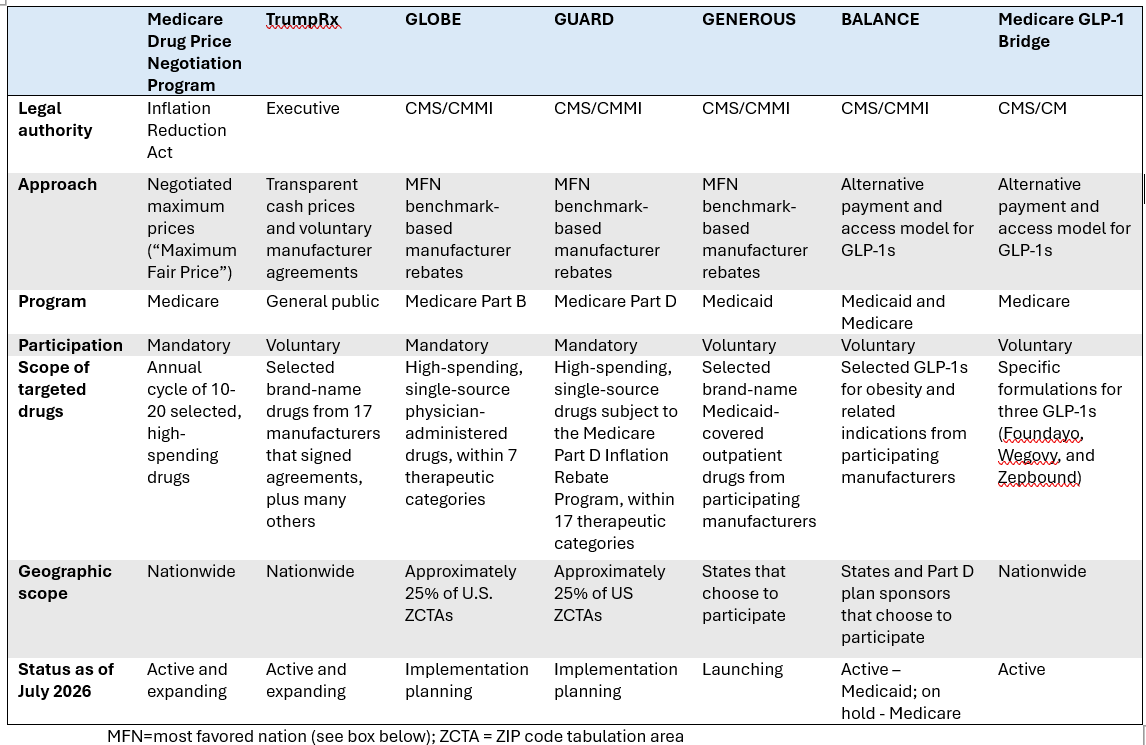
Exhibit 2 summarizes key aspects of the different initiatives, and Appendix B provides a narrative summary of each. Although these initiatives are often grouped together as efforts to lower drug prices, they intervene at different points in the pharmaceutical payment process. Some directly affect prices paid for drugs, some increase manufacturer rebates and thereby reduce net program spending, and others give consumers access to discounted cash prices. As a result, lower federal or state spending would not necessarily translate directly or immediately into lower OOP costs for patients.
Exhibit 2. Key characteristics of select/key federal drug price reduction initiatives
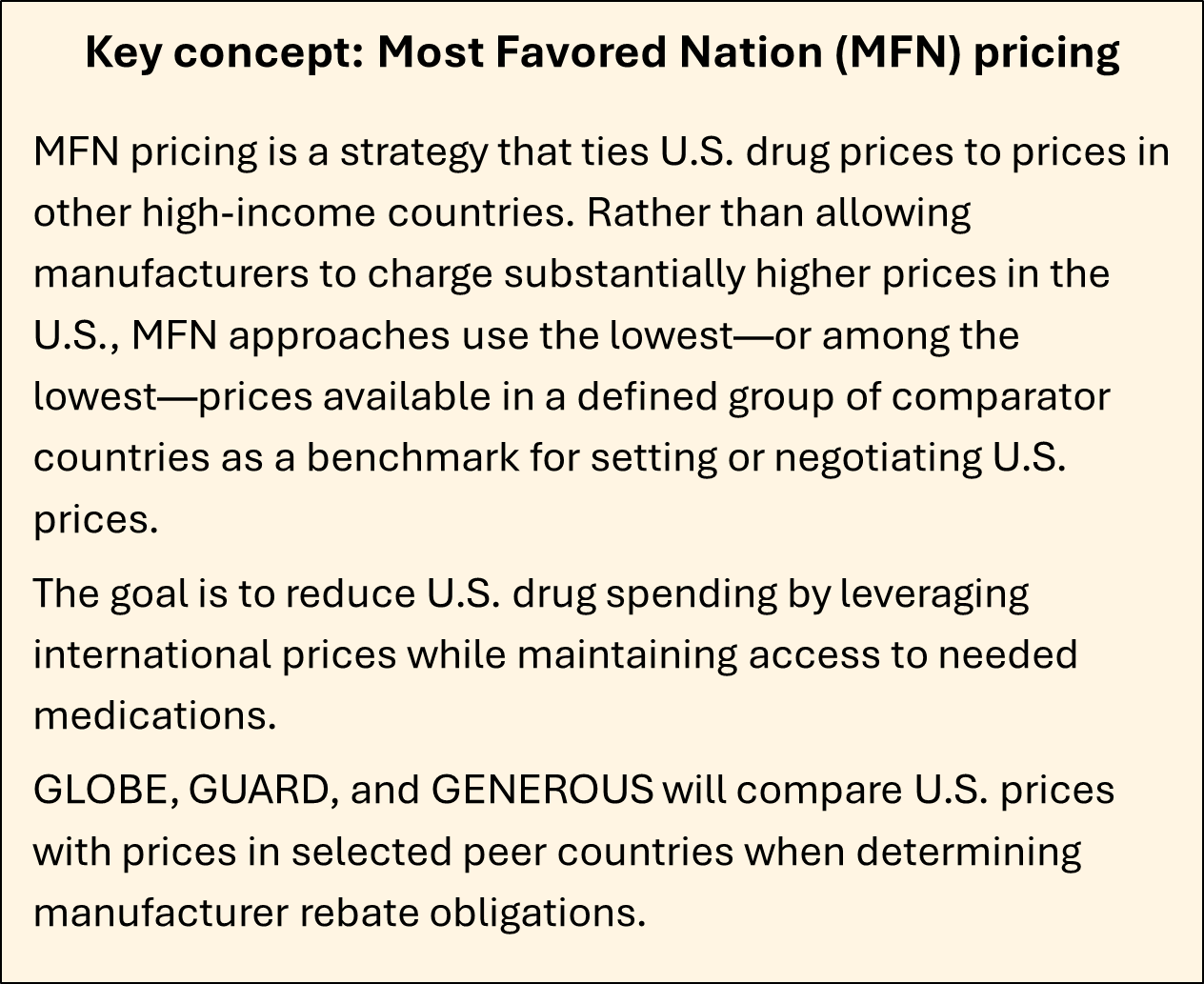
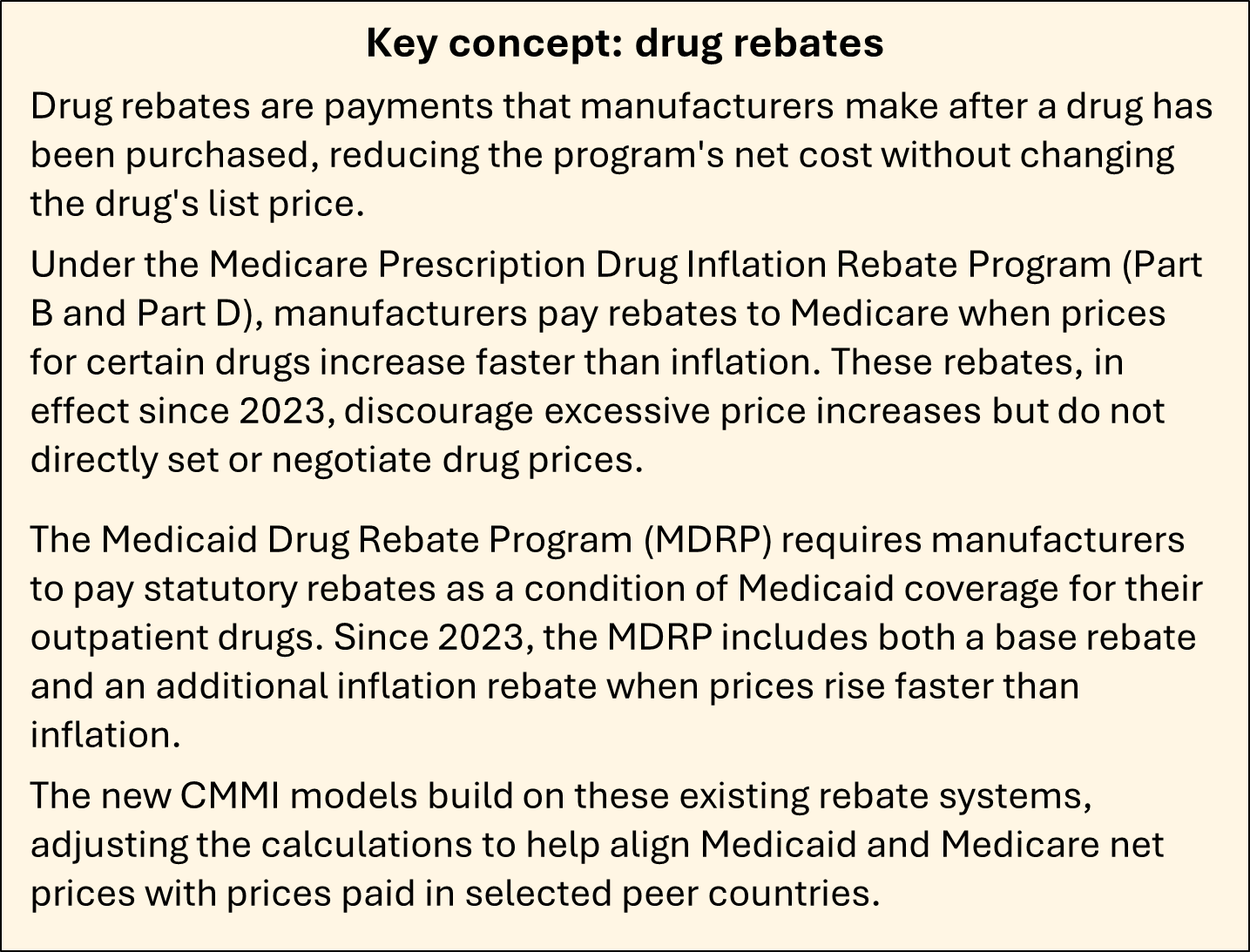
Several of the initiatives (GLOBE, GUARD, GENEROUS) use Most Favored Nation pricing as the new way in which the ultimate cost of the drug will be set, and these same initiatives use rebates to the programs as the means to collect the difference between initial expenditures and the final cost. The new calculations will increase the size of the rebates above the longer-standing Medicare inflation rebates. See boxes for an explanation of these two key pricing concepts.


How will patients be affected?
Patients may be affected by this set of initiatives in at least four ways: lower point-of-sale OOP costs; improved access to uncovered, restricted, or unaffordable drugs; lower premiums or more generous benefits over time; and improvements to program sustainability due to program cost reductions. Also, some groups of patients will see the cost benefits more than others. Below we discuss how this plays out for each initiative to the extent we know now.
Medicare Drug Price Negotiation Program
The percentage of beneficiaries who use the set of negotiated drugs is significant: about 15% of all Part D enrollees use one or more of the 10 drugs negotiated in the first cycle (ASPE 2023), and about 10% of Part D enrollees use one or more of the 15 drugs negotiated in the second cycle, whose prices will take effect in January 2027 (5.3 million people out of 55.7 million with Medicare Part D coverage) (CMS 2025a; CMS 2025b).
For those beneficiaries who use the applicable drugs, the amount they will save is hard to know, because their cost responsibilities vary by Part D plan and change often. Most Part D plans have an annual deductible amount, which can be as high as $615 in 2026 (Cubanski and Damico 2026). For drugs subject to the deductible, beneficiaries generally pay the plan’s negotiated price until the deductible is met. After they reach the deductible, because the negotiated drugs are likely be classified by the plans as “preferred brand drugs,” a majority of beneficiaries would continue to face a co-insurance amount, such as 21 to 25 percent of the cost of the drug, although some plans charge a fixed co-payment instead (Cubanski and Damico 2026). These percentage-based payment amounts and monthly payments toward a deductible would be lower because of the lower negotiated prices. There is a Part D cap on total OOP costs for all Medicare beneficiaries of $2,100.
In contrast, beneficiaries who use these drugs who would not see lower costs directly include:
Beneficiaries who already met their deductible in a plan that charges fixed copayments rather than co-insurance amounts for drug purchases. The group with plans having fixed co-payment policies has shrunk in recent years but still represents about 44% of the 31 million beneficiaries who chose a Medicare Advantage plan with Part D rather than a standalone Part D plan (Ibid.);
Beneficiaries with income no more than 150% of the poverty level, who already receive low-income subsidies to shield them from these costs; and
Beneficiaries with total prescription drug OOP costs for the year more than the capped amount, after which their cost-sharing drops to $0. While the cap is $2,100 per year, patients may often reach the cap without having to pay this full amount because of the specific method for calculating their total (MedPAC 2025).
CMS projects that negotiated prices will reduce beneficiaries’ aggregate OOP costs by $1.5 billion in 2026 for the first 10 negotiated drugs and by $685 million in 2027 for the 15 drugs negotiated in the second cycle (CMS 2024, CMS 2026). The projections are for reduced costs under the projected defined standard benefit design; actual savings will vary with beneficiaries’ enrollment decisions and plan designs, cost-sharing arrangements, and medication use.
TrumpRx
The new website offers a clear cost benefit for uninsured and some insured patients in high-deductible plans who choose to use TrumpRx to compare prices, and need a drug that is discounted on the website (Pines, 2026). TrumpRx has broad potential applicability, since approximately 28 million Americans (8.3%) are uninsured (Cohen and Briones 2026) and about 27% of Americans under age 65 are in high-deductible health plans (HDHP) (Cohen and Briones 2024). Also, around 7.5 million people over age 65 with some Medicare coverage do not have Part D or other prescription drug coverage (MedPAC 2025). However, the number of Americans who will need a drug that is discounted on the website and could realize savings is unknown and likely growing, as the website adds more medications and the administration continues to negotiate discounts from manufacturers.
Patients with insurance may find it difficult to know if using TrumpRx will save money for them, because spending through the platform typically does not count toward insurance deductibles or annual OOP maximums. Unless it does get counted, immediate benefits for patients may be offset by later expenses, since any patient with health expenses in a year beyond their deductible or OOP maximum would need to pay for other, additional health care expenses until they reach the total deductible amount or OOP maximum (Levins 2026). Recently, two private-sector agreements have proposed mechanisms that could allow the payments to count toward some insurance plans’ deductibles, but CMS will need to issue regulations to allow for this (FTC 2026, Niasse and Godoy 2026).
GLOBE
CMS intended that patients should share in the savings from GLOBE, requiring that patient copay calculations be based on the lower MFN-based prices for drugs included in the model. However, the percentage of Medicare patients who need one of the 62 Part B (clinician-administered) drugs that CMS listed in the proposed rule for GLOBE is estimated to be fewer than 7% of Medicare fee-for-service beneficiaries, and most of that group has supplemental Medicare insurance (such as Medicaid, Medigap, or retiree coverage) that covers their copay expenses.
Many Medicare beneficiaries with supplemental coverage may see little or no immediate reduction in their OOP costs for drugs because their supplemental insurance (Medigap) already pays some or all of their Part B cost sharing (Frazier, Tripp, and Gustafson 2026). Note that as of this writing, CMS is still finalizing model details. Because it is a test, if an evaluation finds benefits over the next few years from a model, even if its reach is limited, it could be expanded to include more drugs and more beneficiaries for greater potential impact.
GUARD and GENEROUS
The GUARD model has a potentially wider reach within Medicare than its sister model GLOBE. With its Part D focus and inclusion of Medicare Advantage plans as well as Part D plans serving fee-for-service beneficiaries, it may incorporate favorable MFN pricing for over 170 drugs, accounting for about $93 billion or 32% of all Part D drug spending (Getachew et al. 2026). Unlike GLOBE, GUARD does not appear to require that the model’s rebate savings be directly passed through to beneficiaries at the point of sale. CMS nevertheless expects the model to reduce beneficiary OOP costs, presumably through downstream effects on Part D plan pricing and benefit design.
Medicaid beneficiaries in states that will participate in GENEROUS, as in other states, do not and will not face significant OOP costs for needed medications given tight cost-sharing limits under Medicaid. However, because the GENEROUS model includes CMS-negotiated standardized coverage criteria for participating drugs in participating states, Medicaid beneficiaries in states with previously more restrictive coverage requirements could experience improved access to those medications.
BALANCE and Medicare GLP-1 Bridge
The BALANCE model to improve patients’ weight management options, and the related short-term Medicare GLP-1 Bridge demonstration could impact many millions of Medicare and Medicaid beneficiaries, since more than 70% of U.S. adults have obesity or screen as overweight (CMS 2026). The main effect will be to give them a new, better option to manage their weight, which should lead to better health and lower long-term medical costs. Under BALANCE, Part D sponsors and state Medicaid agencies will be able to expand their coverage of GLP-1 drugs due to the lower negotiated prices. Also, providing the newly required access to lifestyle supports along with the GLP-1s should improve long-term success over the drugs alone. The actual reach of the program in Medicaid will depend on state participation, which is unknown at this writing.
As a prelude to the Medicare arm of BALANCE, CMS has implemented the short-term Medicare GLP-1 Bridge demonstration to operate through December 2027. The demonstration gives Medicare beneficiaries enrolled in Part D access to GLP-1s for weight management for a $50 copay per month (CMS 2026). Unlike BALANCE, it is not operated through Part D plans, so beneficiaries’ expenses do not count towards Part D deductibles or maximum OOP expenses, and there is no required lifestyle-support component.
Overall outlook
The actual, longer-term effects of these initiatives on patients will depend not only on CMS’ decisions as models are finalized, but also importantly on the strategic choices of not only manufacturers, but also other stakeholders including Medicare Advantage Plans, Part D plans and plan sponsors, state Medicaid agencies, Medicaid managed care organizations, and Pharmacy Benefit Managers. Further, the strategic choices of these other stakeholders will likely have ripple effects not only on patients, but also on provider organizations, pharmacies, clinician prescribers, and private payers.
The initiatives focused on Medicare and Medicaid should reduce federal and state spending for the selected drugs in those programs relative to pre-initiative spending. The Medicare Drug Price Negotiation Program alone has been projected to reduce Medicare drug spending by $14.5 to over $18 billion (multiple estimates) as a result of the success of negotiations from rounds 1 and 2 (MedPAC 2026, CMS 2025, CMS 2024). Reducing spending by many billions of dollars as these initiatives could do could help improve the sustainability of Medicare and Medicaid as their leaders continue to grapple with year-over-year cost increases and an aging population.

However, because the negotiations and the CMMI models only affect part of a manufacturer’s business, there is potential for manufacturers to shift their pricing strategies to replace some of that revenue. We can observe that many drugs’ prices have increased, as others decreased, however, it is difficult to know whether the reason is the pricing policy changes, because so many factors affect pricing strategies from year to year (Vizient 2025).
For many of these initiatives, some of the most important potential benefits are indirect and longer-term. Beyond reducing spending, the improved access to medications that comes with lower costs may well help reduce downstream health problems that affect patients’ quality and length of life as well as overall medical costs.
Author contact: Sue Felt-Lisk sue@bluemonthealth.com
References
CMS. “CMS Delivers Savings for Seniors on 15 Major Drugs for Cancer and Chronic Disease.” CMS Newsroom, November 25, 2025a. https://www.cms.gov/newsroom/press-releases/cms-delivers-savings-seniors-15-major-drugs-cancer-chronic-disease
CMS. “Medicare and Medicaid by the numbers.” Medicare and Medicaid 60 Anniversary, July 2025b. https://www.cms.gov/files/document/medicare-and-medicaid-numbers.pdf
CMS. “Medicare Drug Price Negotiation Program: Negotiated prices for initial price applicability year 2026.” Fact Sheet, August 2024. https://www.cms.gov/files/document/fact-sheet-negotiated-prices-initial-price-applicability-year-2026.pdf
CMS. “Medicare Drug Price Negotiation Program: Negotiated prices for initial price applicability year 2027.” Fact Sheet, November 2025. https://www.cms.gov/files/document/fact-sheet-negotiated-prices-ipay-2027.pdf
CMS. Fact Sheet: “Medicare GLP-1 Bridge: GLP-1 drugs for $50 a month.” June 2026. https://www.medicare.gov/publications/12234-medicare-glp-1-bridge-glp-1-drugs-for-50-a-month.pdf
CMS. “BALANCE (Better Approaches to Lifestyle and Nutrition for Comprehensive hEalth) Model.” Last updated 6/22/2026. https://www.cms.gov/priorities/innovation/innovation-models/balance
Cohen, RA and EM Briones. “Health insurance coverage: early release of estimates from the National Health Interview survey, 2025.” CDC, National Center for Health Statistics, May 2026. https://www.cdc.gov/nchs/data/nhis/earlyrelease/Health-Insurance-Coverage-Early-Release-of-Estimates-2025.pdf
Cohen, RA and EM Briones. “Enrollment in high-deductible health plans among people younger than age 65 with private health insurance: United States, 2019-2023.” CDC, National Health Statistics Report, No. 214, December 5, 2024. https://www.cdc.gov/nchs/data/nhsr/nhsr214.pdf (Note that the statistic used in this report was calculated from this citation as follows: 41.7% of privately insured people younger than age 65 were enrolled in a high-deductible health plan (HDHP) in 2023, and the percentage of people younger than age 65 with private health insurance was 65.1% in 2023; multiplying the two shows the percentage of Americans under age 65 with HDHPs in 2023 was 27.1%.)
Cubanski J and A Damico. “Medicare Part D enrollment, premiums, and cost sharing in 2026.” KFF, June 2026. https://www.kff.org/medicare/medicare-part-d-enrollment-premiums-and-cost-sharing-in-2026/
Federal Trade Commission (FTC). “Express Scripts, Inc., et al.; Analysis of agreement containing consent order to aid public comment.” Federal Register, vol. 91, no. 29, February 12, 2026: 6640-6642. https://www.govinfo.gov/content/pkg/FR-2026-02-12/pdf/2026-02844.pdf
Frazier L, A Tripp, and K Gustafson. “How MFN pricing in Part B may affect beneficiary out-of-pocket costs.” Avalere Health, January 2026. https://advisory.avalerehealth.com/insights/how-mfn-pricing-in-part-b-may-affect-beneficiary-oop-costs
Freed M, N Ochieng, J Cubanski, and T Neuman. “Key facts about Medigap enrollment and premiums for Medicare beneficiaries.” KFF, October 18, 2024. https://www.kff.org/medicare/key-facts-about-medigap-enrollment-and-premiums-for-medicare-beneficiaries/
Getachew B, K Stengel, M Brown, and T Meyer. “Over 170 drugs may qualify for inclusion in the GUARD model.” Avalere Health, February 2026. https://advisory.avalerehealth.com/insights/over-170-drugs-may-qualify-for-inclusion-in-the-guard-model
Hartman M, AB Martin, D Lassman, A Catlin, and The National Health Expenditure Accounts Team. “National health care spending Increased 7.2 percent in 2024 as utilization remained elevated.” Health Affairs, vol. 45, no. 2, February 2026: 110-120. https://www.healthaffairs.org/doi/pdf/10.1377/hlthaff.2025.01683
Kearney A, J Montalvo, A Kirzinger, and L Hamel. “Public Opinion on Prescription Drugs and their Prices.” KFF Poll Finding, March 2026. https://www.kff.org/health-costs/public-opinion-on-prescription-drugs-and-their-prices/?utm_source=chatgpt.com
Levins H. “Unpacking the federal drug price reduction struggle.” Health Care Payment and Financing. Penn Leonard Davis Institute of Health Economics, June 2026. https://ldi.upenn.edu/our-work/research-updates/unpacking-the-federal-drug-price-reduction-struggle/
MedPAC. “The Medicare prescription drug program (Part D) status report.” Chapter 13, Report to the Congress: Medicare Payment Policy. March 2026. https://www.medpac.gov/wp-content/uploads/2026/03/Mar26_MedPAC_Report_To_Congress_SEC.pdf
MedPAC. “The Medicare prescription drug program (Part D) status report.” Chapter 12, Report to the Congress: Medicare Payment Policy. March 2025. https://www.medpac.gov/wp-content/uploads/2025/03/Mar25_Ch12_MedPAC_Report_To_Congress_SEC.pdf
Niasse A, and J Godoy. “CVS settles with FTC, agrees to count TrumpRX drug purchases towards insurance.” July 14, 2026. https://www.reuters.com/world/cvs-settles-with-ftc-agrees-count-trumprx-drug-purchases-towards-insurance-2026-07-14/
Ochieng N, J Cubanski, and T Neuman. “Coverage among Medicare beneficiaries: Most in Traditional Medicare have supplemental coverage that helps cover Medicare cost sharing but more than three million don’t.” KFF, December 19, 2025. https://www.kff.org/medicare/a-snapshot-of-sources-of-coverage-among-medicare-beneficiaries/#:~:text=To%20help%20with%20cost%20sharing%20for%20Medicare-covered%20services,pay%20an%20average%20of%20%242%2C600%20annually%20in%20premiums.
Office of the Assistant Secretary for Planning and Evaluation (ASPE). “Comparing Prescription Drugs in the US and Other Countries: Prices and Availability.” Contractor Project Report, January 2024. https://www.ncbi.nlm.nih.gov/books/NBK611301/
Office of the Assistant Secretary for Planning and Evaluation (ASPE). “Inflation Reduction Act Research Series – Medicare Drug Price Negotiation Program: Understanding development and trends in utilization and spending for the selected drugs.” Research Report, December 14, 2023. https://www.aspe.hhs.gov/sites/default/files/documents/4bf549a55308c3aadc74b34abcb7a1d1/ira-drug-negotiation-report.pdf
Pines J. “Here’s the full TrumpRx discounted drug list and who it actually helps.” Forbes, February 6, 2026. https://www.forbes.com/sites/jessepines/2026/02/06/heres-the-new-trumprx-discounted-drug-list--who-it-actually-helps/
Roehrig C and A Turner. “Projections of the non-retail prescription drug share of national health expenditures.” Altarum, July 2022. https://drugchannelsinstitute.com/files/Projections-of-Non-Retail-Drug-Share-of-NHE-2022.pdf
The White House. “Fact sheet: President Donald J. Trump announces expansion of TrumpRx.gov to bring Americans transparency and choice on everyday medicines.” May 18, 2026. https://www.whitehouse.gov/fact-sheets/2026/05/fact-sheet-president-donald-j-trump-announces-expansion-of-trumprx-gov-to-bring-americans-transparency-and-choice-on-everyday-medicines/
Vizient. “Early impacts of the IRA’s Medicare Drug Price Negotiation Program: Pricing trends for Medicare Parts B and D.” December 2025. https://www.vizient.com/insights/reports/early-impacts-of-the-iras-medicare-drug-price-negotiation-program-pricing-trends